The median Key West home sold for about $1.0M in February 2026 with 102 days on market, and by July the list-side median hovered near $1.1M with days on market drifting to 114. Buyers arriving from the portals see those numbers and assume the mortgage rate is the variable they need to solve for. In this market, it isn't. The variable is the insurance stack, and one document decides most of it.
The friction that shows up in escrow
Here is the pattern that catches out-of-state buyers around day 14 of due diligence. Their lender asks for proof of flood coverage. Their agent asks for the Elevation Certificate. The seller shrugs. The prior policy was written under a grandfathered rate the seller inherited from the previous owner, no fresh EC on file, no recent quote in the buyer's name. When the buyer's own quote comes back through Risk Rating 2.0, it is priced to the address, not the policy history, and the monthly number the buyer walked into contract with no longer works.
That is the friction. It is not exotic. It happens because two things changed at once. FEMA's Risk Rating 2.0 stopped pricing flood premiums by zone in 2022 and started pricing them building-by-building. And on January 1, 2026, Citizens Property Insurance expanded its flood-coverage mandate to any policy insuring a dwelling of $400,000 or more, regardless of zone, with the requirement extending to every Citizens wind policy on January 1, 2027.
In a market where nearly every insurable home crosses $400,000 in rebuild cost, that combination means flood insurance is effectively mandatory, and the premium is set by facts about the specific structure that the seller may not have documented in years.
Why the flood zone stopped being the answer
For most of the last five decades, a Keys buyer's first insurance question was "what zone is it in?" X, AE, VE. Fair Insurance Rates for Monroe, the local nonprofit known as FIRM, puts it bluntly: since 2022, flood zones don't matter the way they used to. Risk Rating 2.0 prices each address on distance from water, construction type, replacement cost, prior flood history, and the height of the first floor above Base Flood Elevation. FIRM estimates that more than 90 percent of Monroe County homeowners saw increases under the new methodology.
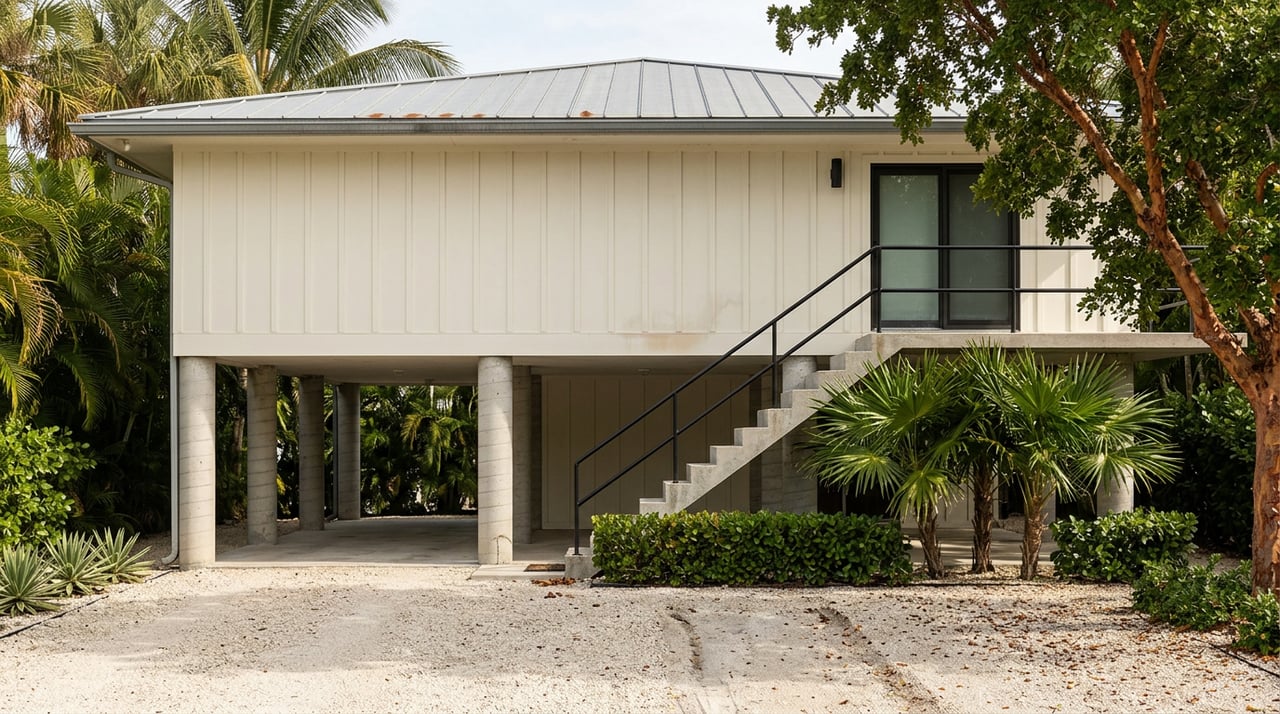
Two homes on the same Old Town street, in the same AE flood zone, on the same lot size, can quote hundreds of dollars apart in annual flood premium because one sits nine inches lower than the other and one has its air handler at grade instead of on a stand.
That is where the Elevation Certificate earns its keep.
The Elevation Certificate math, on one property
An EC is a surveyor's document. For an A-zone property it records the Finish First Floor height, the Base Flood Elevation for that specific location, and the lowest elevation of mechanical equipment such as air conditioning and electrical. For a V-zone property it records the underside of the lowest horizontal cross-member instead. Consider two hypothetical homes in an AE8 zone, meaning the BFE at that location is 8 feet above sea level:
| Home | Finish First Floor | Position vs. BFE | Premium impact |
|---|---|---|---|
| A | 9 ft 6 in | 1 ft 6 in above flood | Lowest available rating |
| B | 7 ft 3 in | 9 in below flood | Higher rating, though not as steep as 3 ft below |
| C | 5 ft 0 in | 3 ft below flood | Substantially higher |
The document doesn't change the physical house. It changes the price the insurer quotes it at. A May 2026 industry guide from Team239 notes that private carriers in Florida don't always require an EC, but presenting one is a negotiation tool when a carrier's automated model overestimates elevation. Older certificates can go stale when FEMA updates Flood Insurance Rate Maps or when the building is physically altered, and the current form insurers prefer is FEMA Form FF-206-FY-22-152. A previous owner's EC is often still usable if the footprint and maps have not changed since it was issued.
If you are the buyer and no EC exists, a fresh survey done during your inspection window is one of the highest-return diligence dollars you will spend in this market.
The 2026 Citizens rule, translated
Citizens is Florida's insurer of last resort and still writes a large share of Keys wind policies because Monroe County has the strongest building code in the country and private wind carriers are selective. The phased rule reads short but matters a lot:
- Effective 1/1/2025: Citizens wind policies at $500,000+ dwelling value must carry flood coverage
- Effective 1/1/2026 (now): the threshold drops to $400,000
- Effective 1/1/2027: every Citizens personal-residential wind policy must carry flood, regardless of value or zone
- Condominium unit-owner and tenant-content policies are exempt until the final phase
Coverage A is rebuild cost, not market value, and in the Keys the two are not close. A modest concrete-block home a mile off the water can cross $400,000 in rebuild cost long before it crosses that in list price. The practical read: if the seller is on Citizens and does not already carry flood, expect that policy structure to change at your closing, and price it into the offer.
There is also a 30-day NFIP waiting period between purchase and coverage becoming effective, with narrow exceptions at closing. Private flood carriers can move faster, and both NFIP and approved private flood satisfy the Citizens requirement.
The 50-percent rule that quietly limits older cottages
Key West joined the National Flood Insurance Program in 1971, and its flood maps first became effective December 31, 1974. Structures built before that date were grandfathered at their existing elevations. The catch, spelled out in the City of Key West's own FAQ, is that grandfathered status ends once cumulative renovations exceed 50 percent of the building's market value. At that point the building must be elevated to the current Design Flood Elevation, which is BFE plus one foot, and BPAS permits require 1.5 feet above BFE.
For a buyer eyeing a pre-1975 Old Town cottage with plans to open the floor plan, that ceiling is the number to model against, not the asking price. Market value for the calculation is derived from the Monroe County Property Appraiser's improvement value with a 15 percent adjustment. Historic structures listed on relevant registers have a carve-out from the elevation requirement itself, but their utilities and machinery still have to be raised.
What Key West gives back: CRS Class 5
The city participates in FEMA's Community Rating System and, as of April 2026, holds a Class 5 rating. Inside the Special Flood Hazard Area, that translates to up to a 25 percent discount on NFIP flood premiums. It does not apply to private flood policies, and it does not apply outside the SFHA. But for a buyer in AE or VE, that discount is real and stackable with a strong EC.
How this changes an offer
The move for a mid-market Key West buyer in 2026 is not to shop harder on rate. It is to run three insurance quotes before the inspection period ends: an NFIP quote, a private-flood quote, and a Citizens wind quote at the actual replacement cost your lender uses. If those numbers do not fit the monthly, the concession to ask for is a credit sized to a fresh Elevation Certificate and any wind-mitigation inspection needed to secure credits under the OIR-B1-1802 form updated in April 2026.
Roof condition matters too. Wind carriers generally want roofs under 20 years old, and concrete performs best on premium, followed by metal, then tile, then shingle. Class A opening protection on all doors and windows unlocks the wind-mitigation credits the pricier homes lean on to stay insurable.
At July 2026 conditions with roughly 1,389 active listings across Monroe County and 16.3 percent of listings cutting price, sellers have room to accept insurance-linked credits that would not have moved during the 2021 to 2022 stretch. Buyers who show up with the EC in hand and the quotes in writing are the ones setting terms.
FAQ
Do I need a new EC if the seller has one from 2019? Often no. If the building footprint has not changed and the FIRM panel covering the property has not been revised, an older EC on the current form can still be used. If either has changed, plan on a new survey.
Is a home in Zone X exempt from the Citizens flood rule? No. The Citizens dwelling-value rule applies regardless of zone. A Zone X home insured at $400,000 or more on a Citizens wind policy needs flood coverage in 2026, and every Citizens wind policy needs it in 2027.
Can I close without flood insurance if my lender is not federally backed? Sometimes, but if the wind policy is with Citizens the flood requirement is a Citizens condition, not a lender condition. Non-compliance can cause the wind policy to non-renew.
What about condos? HO-6 unit-owner and tenant policies are exempt from the Citizens flood requirement until the 2027 final phase. The building's master policy is the document to review during a condo purchase.
If you are working through what a specific Key West address actually costs to insure and own in 2026, that math is worth doing before you write the offer, not after. Jamie Lynne Walker works this stack alongside her clients as part of due diligence, coordinating with local surveyors and insurance agents so the number in your offer is the number that closes. Start Your Keys Journey. Let's Find Your Home.