Near mile marker 12, the turn onto Shark Key is "announced by a building with a beautiful blue-tiled roof," as Keys Weekly's history column once put it, and that's about all the signage you get. No banner, no welcome sign spelling out amenities, just a roofline you learn to watch for at 55 miles an hour. It's a fitting introduction to an island that keeps almost everything useful to daily life somewhere else.
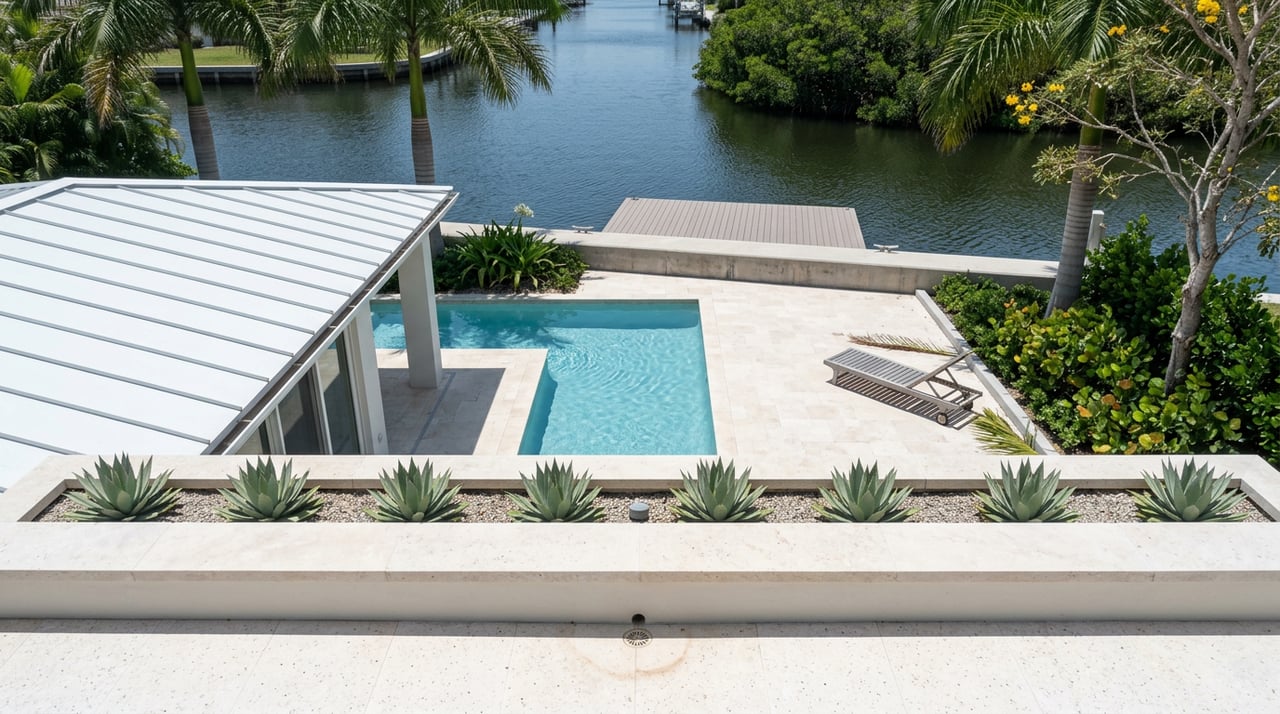
Shark Key itself holds a clubhouse, a lagoon beach, tennis courts and a park behind its gate, developed in the 1980s on land that was once railroad fill from Henry Flagler's Over-Sea Railroad connecting it to Big Coppitt Key. What it doesn't hold is a restaurant, a bar, a boat ramp, or a gas station. For those, a neighbor drives back out the same unmarked entrance and turns toward a stretch of Overseas Highway that is, in its own way, just as reluctant to introduce itself. Everything that matters for a Tuesday night or a Saturday morning sits within a couple of miles of that gate. None of it is where a stranger would expect to find it.
The ramp with no parking lot
Head north from the Boca Chica Road intersection and you'll pass a boat ramp at mile marker 11 that most GPS apps barely register. It's a single lane with no courtesy dock, room for roughly ten trailers, and signage minimal enough that one fishing writer described whizzing right past it before doubling back. There's no ramp-side parking either. The move locals use is to leave the truck and trailer across the highway on the grassy shoulder, then walk back over.
This is also a spot where the paperwork disagrees with itself. Some boat-ramp directories currently list it as closed, while other recent write-ups describe it as open, if bare-bones. That kind of conflicting listing is common for a ramp this size and this quiet, so the practical habit isn't a search engine, it's a call to Monroe County or a check of the Florida Fish and Wildlife Conservation Commission's boat ramp page before you hook up the trailer. Once you're through, the water opens into Similar Sound, a known tarpon haunt where the channel runs under the highway bridge and out toward a scatter of small islets worth exploring on a calm morning.
The turn is a gas station
Coming back toward Big Coppitt, the most useful turn on this whole stretch of highway isn't marked by anything related to what it leads to. It's a Circle K. Take Boca Chica Road south from that gas station for about a mile and change, and you land at Geiger Key Marina and Smokehouse, a fish-camp restaurant and tiki bar that locals reliably outnumber tourists at, according to Fodor's review of the place.
The schedule here is the kind of thing you only know if you've been going for a while:
- Sunday breakfast runs 9 to 11 a.m., ahead of a Sunday barbecue that starts at 4 p.m. and goes until close.
- Weekday happy hour runs 4 to 6 p.m., Monday through Friday.
- The place is dog-friendly, with its own menu for four-legged guests, and there's usually live music going by early evening.
- Anglers can bring in their own catch to be cooked to order, a fairly literal version of the marina-restaurant model.
It sits on a mangrove-lined boat basin behind an RV park, which is part of why first-timers usually need directions and locals just know the turn.
Big Coppitt's two answers
If Geiger Key is the detour, Big Coppitt Key itself holds the two default answers for a neighbor who doesn't feel like driving the extra mile. Bobalu's Southern Cafe sits right on the highway at mile marker 10, open Tuesday through Saturday from 11 a.m. to 9:30 p.m., serving a menu that mixes Florida Keys seafood (stuffed grouper, conch fritters) with New Haven-style thin-crust pizza and Southern plates like collard greens and meatloaf. It's the kind of place where the accessible ground-level entry and the pizza oven both get equal billing in customer reviews.
The other answer is quieter about itself entirely. The Purple Porpoise Pub is a cash-only dive bar near the Naval Air Station gate on Big Coppitt, the sort of spot Keys Weekly's own history writer admitted curiosity about without ever having walked in. No delivery, no online booking, a TV over the bar and a wheelchair-accessible door. It's not trying to be found by anyone who isn't already headed there.
The contrast that explains it
Put those two halves of the map side by side and a pattern shows up. Inside the Shark Key gate, everything is curated on purpose. A tennis court gets built, a lagoon beach gets maintained, a clubhouse gets scheduled. Outside the gate, on the public side of the highway, almost nothing announces itself. A blue-tiled roof stands in for a sign. A gas station stands in for a street marker. A boat ramp gets described differently by two different directories in the same year, and the correct response is a phone call, not a search bar.
That isn't a knock on the area. It's closer to the actual texture of living on this stretch of the Lower Keys, where the private infrastructure is polished and the public infrastructure is plain, cash-friendly, and built for people who already know where they're going. Neighbors here don't navigate by street number. They navigate by the Circle K, the blue roof, and the Sunday barbecue that starts at four.
If you're weighing whether that kind of quiet, habit-based rhythm fits the way you want to live, Jamie Lynne Walker knows this stretch of highway turn by turn. Start Your Keys Journey — Let's Find Your Home.